
How to Choose the Right Air Duct Cleaning Company in Chelsea
Any company can hand you a before-and-after photo of a dirty duct. The real question is whether their equipment actually creates the negative pressure needed to pull contamination out of a 1920s steel duct system in Chelsea – or whether it just stirs that debris loose and pushes it toward the rooms where you sleep. Choosing an air duct cleaning company in Chelsea comes down to verifying equipment, scope, and documentation, not comparing star ratings. If you’d rather have a trained eye do the vetting, call (866) 979-5520.
Here’s the technical checklist we’d use ourselves if we were hiring this out – the same one we apply when we treat a Chelsea building’s system.
What equipment standard actually separates a qualified contractor?
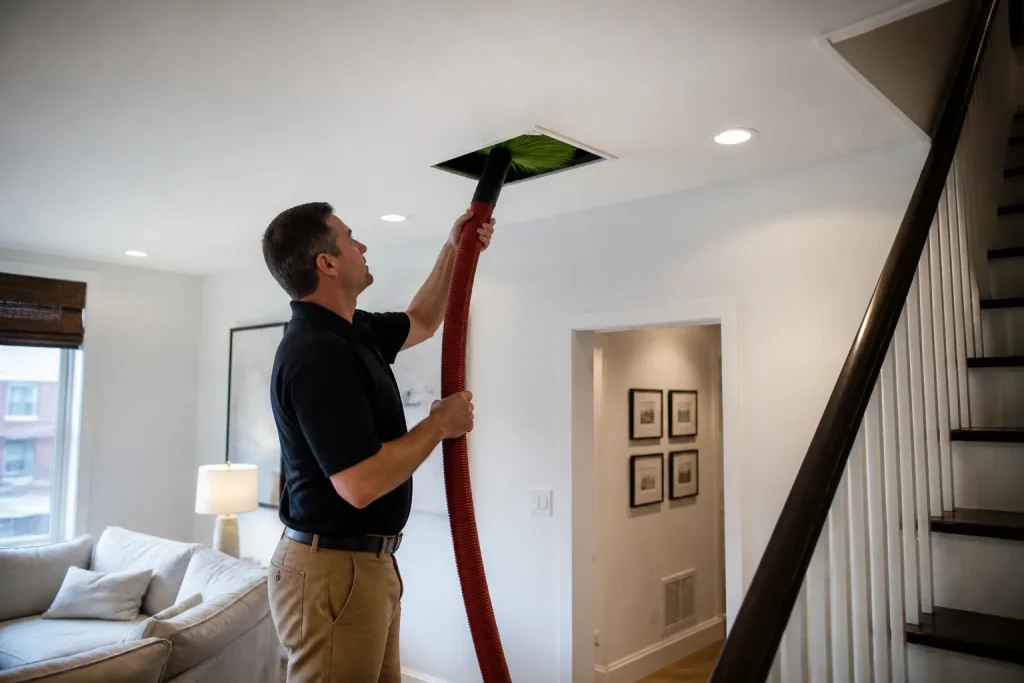
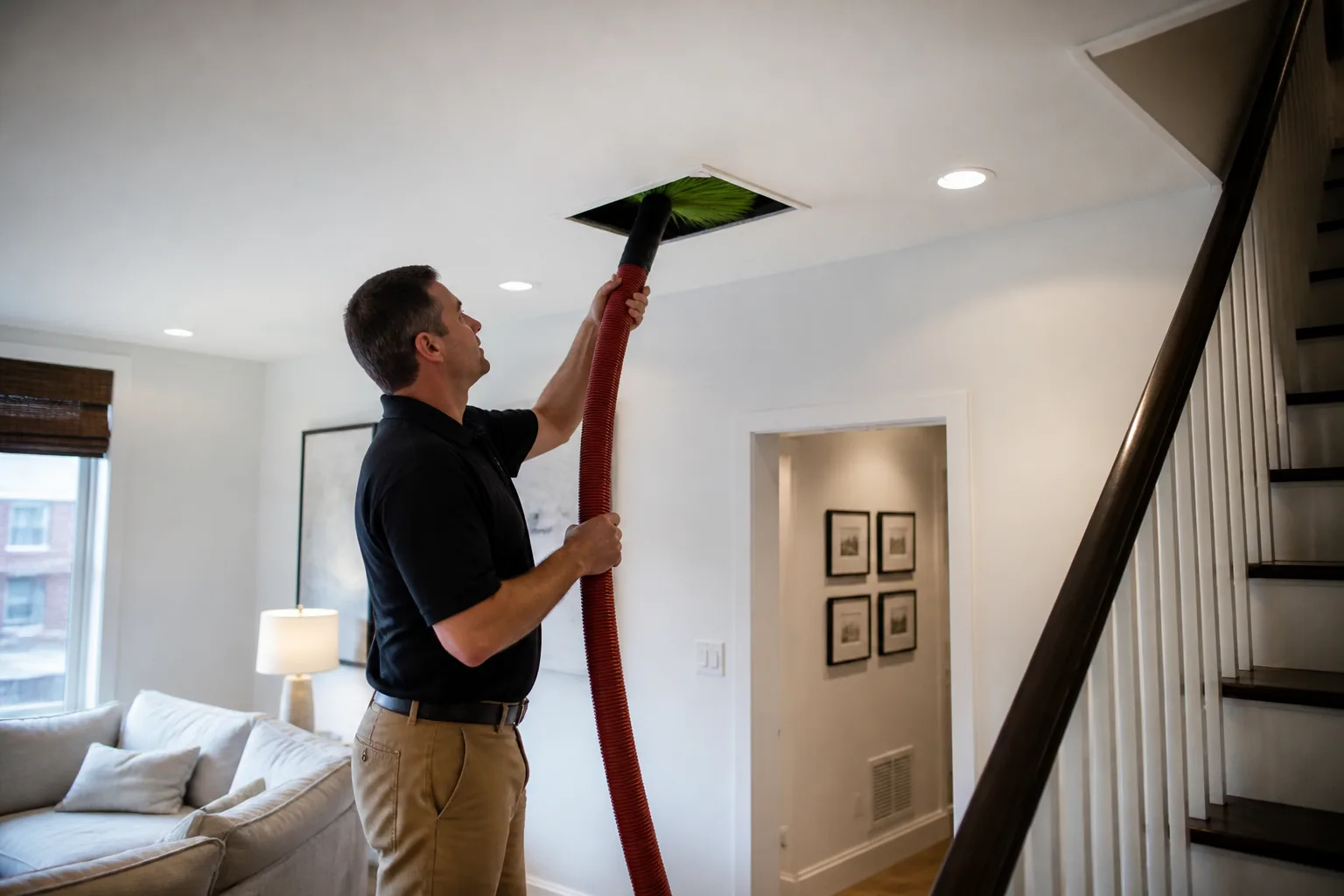
A real duct cleaning company brings a purpose-built negative-pressure system, not a shop vac with a logo slapped on the side. The difference matters because proper source removal depends on creating and holding negative pressure inside the duct network while agitation breaks debris loose from the walls. Without that pressure differential, loosened dust simply resettles downstream or drifts into living space.
In Chelsea’s pre-war buildings, ducts are often original galvanized steel – narrow, sometimes oddly routed, and lined in places with dust that’s had decades to compact against the metal. Consumer vacuums and improvised tools can’t move that material. What does the job is equipment like the Rotobrush and Nikro systems that certified contractors work with, paired with HEPA filtration on the exhaust side so the air returning to the room is filtered rather than redistributed.
During the cleaning itself, airborne particulate control is the test of a serious operation. That’s why we run Abatement Technologies air filtration units on site – the filtration handles what’s in the air while the vacuum handles what’s in the ducts. When you interview a Chelsea company, ask two questions: what negative-pressure equipment do you use, and how do you filter the exhaust air during the job? Vague answers are the tell.
Which credentials should you actually verify before you book?
Ratings tell you how a company markets; credentials tell you how it operates. For a Chelsea apartment or building – where duct systems are shared, densely packed, and often irregular – the paperwork matters as much as the work.
- NADCA membership. Membership in the National Air Duct Cleaners Association signals a company follows a recognized industry standard for source removal. Ask for the membership and confirm it’s current.
- EPA-registered sanitizers. If the quote includes sanitizing, ask which products they use and whether they’re EPA-registered. Brands like Honeywell and Aprilaire are widely recognized in air quality treatment, and a technician should be able to name exactly what goes into your system and why.
- Proof of liability insurance. In New York City, working inside a Chelsea building carries real exposure – a nicked flexible duct, a dislodged seal, water intrusion near a coil. Ask for a certificate of insurance before anyone sets foot in your unit. A professional produces it without hesitation.
- A written scope before work starts. The scope should spell out which components are cleaned, how, and what constitutes completion.
None of these are unreasonable requests. A contractor who treats them as an interrogation is telling you something useful.
What should you ask during the quote call?
Your quote call is where a good company and a poor one separate. Most homeowners ask “how much?” first. In Chelsea, the sharper question is “what exactly gets cleaned?” – because a flat rate that covers only the supply runs leaves the dirtiest parts of the system untouched.
Ask specifically whether the quote includes:
- Return plenums and return registers – the return side pulls air back through the system and often carries the heaviest dust load.
- The air handler and blower compartment – if the fan and cabinet are coated, clean ducts downstream still pull contamination through a dirty fan.
- Evaporator and heating coils – a dirty coil hurts efficiency and can harbor microbial growth. This overlaps with HVAC cleaning, and it’s worth asking who handles it.
- Sanitizing, if it’s included – and with what products.
A company that cleans, repairs, and seals the whole system will have straightforward answers here. One that quotes a single price without pausing to ask about your building’s setup almost certainly plans to clean only the easiest portion of the network. Mention dryer vent cleaning while you’re at it: a clogged dryer vent is a leading cause of residential fires, and many Chelsea buildings run it through the same mechanical space as the ductwork. If you need a broader picture of what full-system service looks like, our Chelsea Air Duct Cleaning page covers the full scope.
What does a proper pre-job inspection look like?
No reputable company can accurately price a duct cleaning without seeing the system first. Every building in Chelsea is different – a walk-up with original steel ducts, a converted loft with retrofitted flexible runs, a co-op with a shared rooftop unit. An inspector should look inside the plenum, check the registers, trace the return path, and note where the system is losing air or pulling in contamination.
If a company skips that inspection and quotes a number over the phone, they’re guessing – and the guess will either be padded to protect them or stripped so thin it can’t cover the work. During the inspection, ask how they’ll document what they found. A competent operation will explain what they’re seeing and why it changes the scope. For a fuller explanation of how professional air duct cleaning should be scoped and performed, we walk through the standard in detail on the service page.
A word on method: some of what passes for duct cleaning – the old “spin brush and vacuum with no containment” routine – is genuinely worse than doing nothing, because loosened debris ends up in your breathing air. We aren’t trying to be dramatic; that’s simply why the negative-pressure and filtration questions above are non-negotiable.
What red flags are specific to the Chelsea market?
In Chelsea, the aggressive quote shows up as an unusually low flat rate – sometimes a teaser number designed to get a technician into your apartment, where the real price materializes as “scope” additions. Watch for these:
- A flat rate suspiciously below market. Duct cleaning is labor and equipment. A price that seems too good isn’t covering the work.
- No written scope of work. If it isn’t documented before the job, you have no basis for comparison or complaint afterward.
- No post-cleaning report. You should receive documentation – photos of before and after, a description of what was cleaned, and any findings. Without it, you have no proof the work happened.
- Pressure to sanitize or repair on the spot. Sanitizing is legitimate and worthwhile when there’s microbial growth or odor – but it should be scoped on its own merits, not upsold as a surprise.
- Refusal to name their equipment. A company proud of its Rotobrush or Nikro system will tell you about it.
These patterns are consistent across the neighborhood because the building stock is consistent – older systems, shared components, and homeowners who haven’t had ductwork opened up and don’t know what “normal” looks like. That’s exactly what the bait-and-switch operator is counting on.
When should you call a pro rather than wait?
If your ducts are visibly discharging dust at the registers, if there’s a persistent musty odor when the heat or AC runs, if someone in the household has worsening allergy symptoms that clear up away from home, or if you see debris around the air handler, it’s time to call. Sealing and repair are the other triggers: if the system is losing air or pulling contamination in through gaps, cleaning alone won’t fix it.
Air duct work is not a DIY job. The equipment is specialized and heavy, the risks of resealing a system incorrectly are real, and a household vacuum pushed into a register won’t pull source debris – it just moves it. Call (866) 979-5520. We answer 24/7. Fast dispatch from 7am to 7pm, Sunday through Friday. Our technicians have up to 15 years of experience, and estimates are free.
The Bottom Line
The right company in Chelsea is one that shows you its equipment, explains its method, puts the scope in writing, and proves the work with a report. Compare on those criteria and the low-ball quote loses its appeal. In short:
- Verify negative-pressure equipment and air filtration, not just a logo.
- Confirm NADCA membership, EPA-registered sanitizers, and liability insurance.
- Ask which components get cleaned – returns, plenums, coils, air handler.
- Insist on a pre-job inspection and a written scope.
- Demand a post-cleaning report.
If you’re in Chelsea and need help, Chelsea Air Duct Cleaning offers free estimates – call (866) 979-5520. We handle the whole system: ducts, vents, HVAC, repair and sealing, and air quality sanitizing.
Frequently Asked Questions
Ask about equipment, credentials, and scope, then verify them. A qualified Chelsea company uses professional negative-pressure equipment with air filtration, holds NADCA membership, carries liability insurance, provides a written scope before work, and gives you a post-cleaning report. If a quote call can’t answer those questions clearly, look elsewhere.
Cheap quotes usually mean either a narrowed scope – supply runs only, no returns, plenums, or coils – or a teaser price that grows once the technician is inside your apartment. Proper duct cleaning is labor and specialized equipment, and a price far below the local market won’t cover the work. Call (866) 979-5520 for an honest estimate.
Not always. Sanitizing is worth considering when there’s microbial growth, lingering odor, or allergy concerns, and it should be scoped based on the inspection rather than added as a default. Ask which products are used and whether they’re EPA-registered. We use products from brands including Honeywell and Aprilaire when sanitizing is warranted.
There’s no universal schedule – it depends on the building, the occupants, and what’s in the air. In a Chelsea pre-war building with original steel ducts, a household with pets, or anyone with respiratory concerns, it’s worth having the system inspected periodically rather than waiting for visible dust. A technician can tell you whether cleaning is actually needed at that moment.
Written by the team at Chelsea Air Duct Cleaning.
Need Air Duct Cleaning Help?
Call Chelsea Air Duct Cleaning - the local pro we connect you with is licensed and insured, here with fast help in Chelsea.
(866) 979-5520