
Rotobrush Air Duct Cleaning in Chelsea: A Homeowner’s Guide
When a company says it uses Rotobrush equipment, that’s the start of your evaluation, not the end of it. Rotobrush is a brand of contact-cleaning machinery, and a rotating brush on the end of a vacuum behaves very differently in a six-inch flex run than it does in the rigid galvanized trunk lines running through many of Chelsea’s pre-war buildings. Knowing how the tool actually works tells you whether it’s the right one for your ducts. If you’d rather not sort through it alone, call (866) 979-5520.
Key Takeaways
- Rotobrush is equipment, not a method category. It agitates dust while vacuuming at the point of contact.
- It works well in many residential branch runs and poorly in oversized trunks and collapsed flex.
- Most Chelsea buildings need contact cleaning combined with negative-pressure source removal, not one or the other.
- The right question isn’t “do you use Rotobrush?” but “how will you clean the parts the brush can’t reach?”
How does Rotobrush equipment actually work?
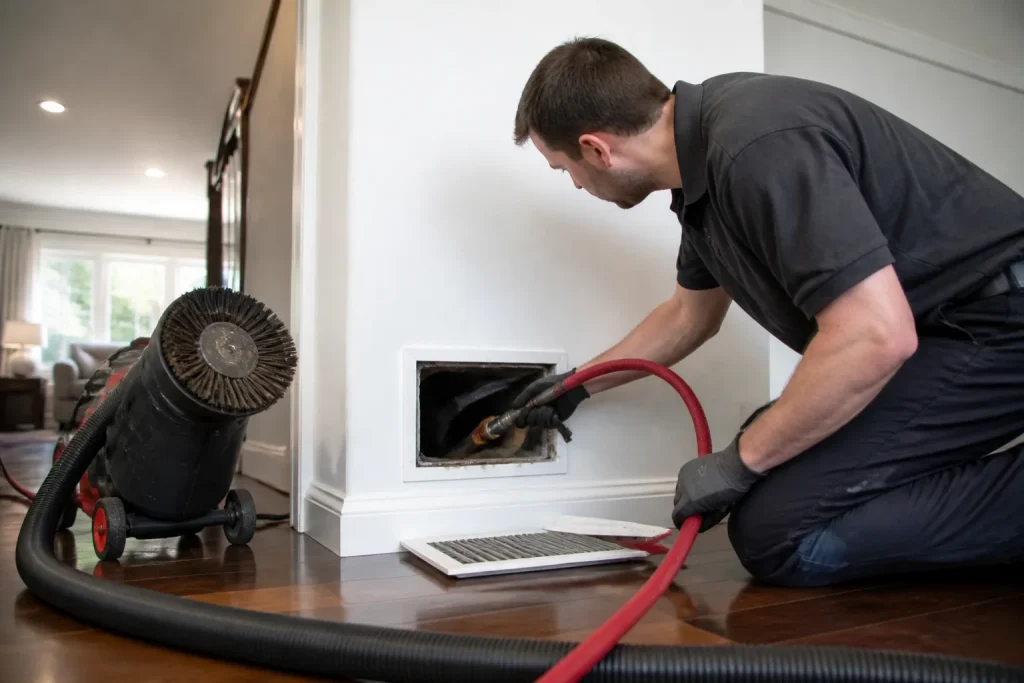
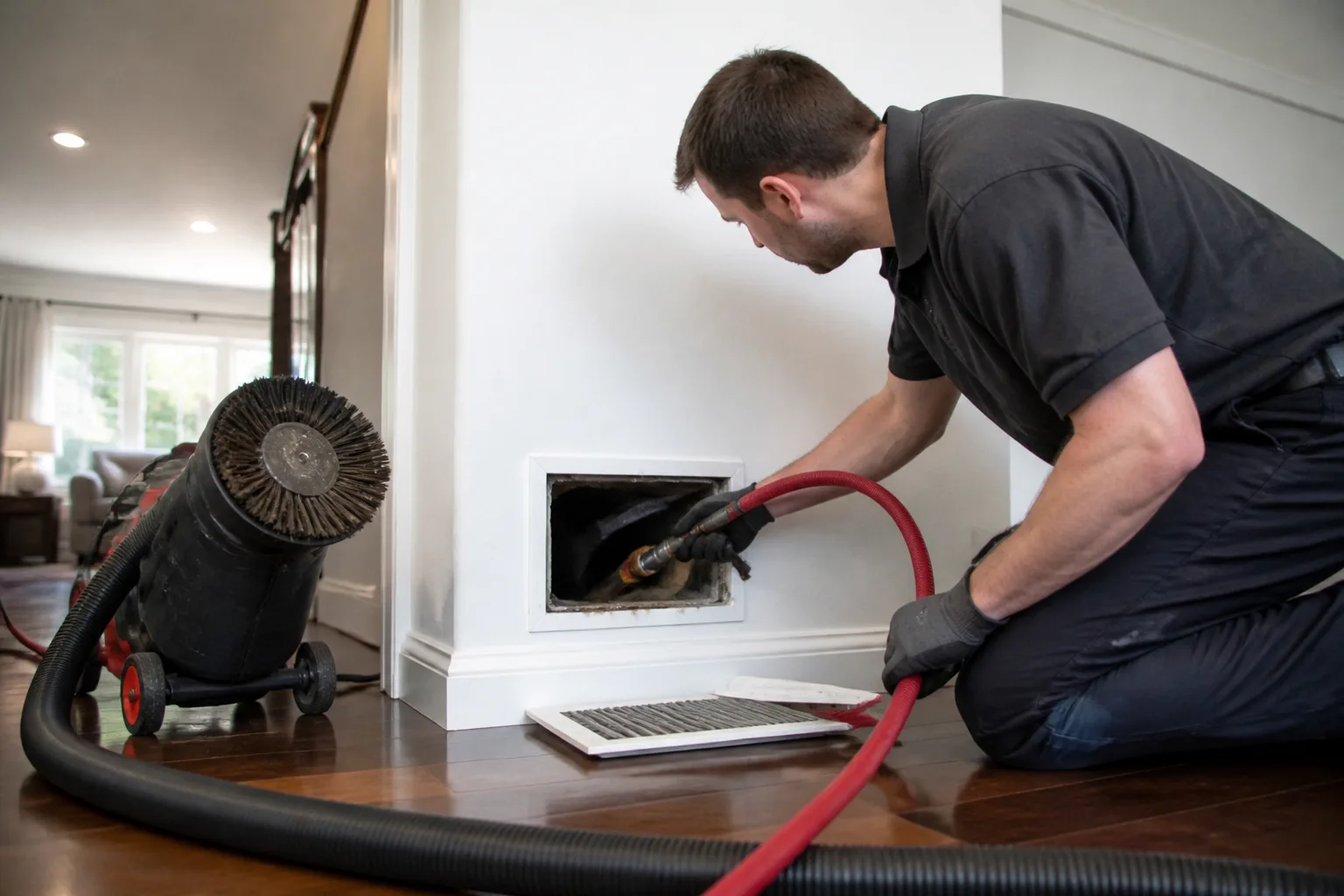
Rotobrush systems clean by contact. A flexible shaft drives a spinning brush or whip through the duct while a high-volume vacuum pulls at the same opening. The brush loosens what’s stuck to the walls; the vacuum captures it before it settles back. That simultaneous action is the whole idea, and it’s why the tool is genuinely useful rather than a gimmick.
Two details matter more than the brand name. First, the vacuum has to be sealed to the duct or you’re mostly moving dust around the room. Second, the brush has to physically reach the surface. In a straight, accessible branch run, it usually does.
Our technicians have up to 15 years of experience with professional-grade equipment from Rotobrush and Nikro, and the honest answer is that no single machine cleans an entire house. Rotobrush is one tool in a complete system. It’s excellent at scrubbing the walls of standard residential runs. It is not designed to generate the sustained negative pressure that pulls loose debris out of a large trunk line, and it can’t clean what it can’t reach. Treat it as a scrubbing tool, not a complete cleaning strategy.
Where does Rotobrush perform well, and where does it fall short?
Rotobrush does its best work in the duct types most common in Chelsea apartments and smaller homes: standard round and oval branch runs, moderate lengths, a few bends, and light-to-moderate buildup of the usual household dust, lint, and pet hair.
Where it struggles:
- Heavily corrugated flex duct. The ridges trap debris in the valleys, and a spinning brush can abrade the inner liner if it’s driven too hard. Skilled operators slow down here; careless ones don’t.
- Collapsed or crushed sections. No brush fixes a duct that’s physically closed. That’s a repair and sealing job, not a cleaning one.
- Oversized trunk lines. A brush sized for a six-inch run doesn’t scrub the full circumference of a large rectangular trunk. Those need negative-pressure source removal and hand work at the access points.
- Long, complex runs with many turns. The shaft loses effectiveness the more it has to bend.
None of this makes Rotobrush a bad tool. It makes it a tool with a defined job. A company that waves the name around without explaining where it stops is telling you something about how carefully they’ll clean your Chelsea home.
How does contact cleaning compare to negative-pressure source removal?
They solve different problems, and the difference is worth understanding before anyone quotes you.
Contact cleaning (Rotobrush-style) scrubs surfaces. The brush agitates contamination and the vacuum catches it at the opening. It’s effective on adhered debris and on branch runs.
Negative-pressure source removal uses a large HEPA vacuum connected to the system to hold the entire duct network under vacuum while technicians work debris loose from access points. Contamination moves toward the collector instead of into your rooms.
The best results come from using both: negative pressure to protect the living space and pull bulk debris, contact cleaning to scrub what’s stuck. During the work itself, our setup includes Abatement Technologies air filtration to control airborne particulates, because containment matters as much as the cleaning. When you get a quote in Chelsea, ask which method they plan for each part of your system. A clear answer is a good sign. A blank look is not.
What do Chelsea’s older building duct systems look like?
Chelsea’s housing stock shapes this more than any brand literature does. A lot of the neighborhood’s buildings date to the early and mid-twentieth century, with a mix of converted walkups, brownstones, and larger apartment buildings. That history shows up inside the ducts.
- Rigid galvanized trunk lines are common in older buildings, often oversized for today’s HVAC equipment and sometimes with seams that have loosened over the years.
- Retrofitted flex duct appears wherever a system was updated, and it’s frequently routed through tight chases with sharp bends.
- Mixed systems are the norm, not the exception: a 1920s trunk feeding newer branch runs, with no consistent configuration from one apartment to the next.
- Prior modifications leave their marks. We regularly find disconnected joints, crushed sections, and gaps that pull unconditioned air into the system.
In a building like this, equipment selection isn’t a brand conversation. It’s a question of which tool fits which duct, section by section. A guide to air duct cleaning is only useful if it acknowledges that variety, because what works on the trunk won’t work on the flex feeding a rear bedroom.
What should you ask a company that uses Rotobrush equipment?
Brand recognition is easy to buy and easy to claim. These questions separate a technician who understands the tool from a crew using its name as a sales line.
- Will you use negative pressure alongside the brush? If the answer is no, ask how they’ll keep debris out of your rooms.
- How will you clean the trunk lines and any duct the brush can’t reach? There should be a specific answer.
- Will you show me before-and-after photos of my own ducts? Anyone can show stock images. Yours should be yours.
- How do you handle crushed or disconnected sections? Cleaning a system with broken joints just recontaminates it. Repair and sealing should be part of the conversation.
- Is the price per system or per vent? Per-vent pricing invites a bigger number later.
Related services in Chelsea: we also handle HVAC cleaning and dryer vent cleaning, since a duct system doesn’t operate in isolation from the equipment and vents it connects to. If you want the full indoor air picture handled by one company, start at Chelsea Air Duct Cleaning.
When should you call a pro instead of looking at equipment lists?
Call a professional when you can see or smell the problem and can’t address it from a register. Visible dust blowing out of supply vents after a system change, musty odors when the air kicks on, a dryer that takes two cycles to dry a load, or a recent renovation that left debris in the returns are all reasons to have the system assessed. Ductwork is enclosed and often inaccessible, and the tools that clean it properly are not available at a hardware store.
We don’t recommend DIY work inside ducts. It’s cramped, often contaminated, and easy to damage flex liner. The right move is a proper evaluation of what your Chelsea system actually looks like. And if allergies or odors point toward microbial growth rather than plain dust, a sanitizing step may belong in the plan; products from Honeywell and Aprilaire, along with Guardsman-grade protective treatments, are part of that process.
If you’ve been told your ducts need cleaning and you’re not sure what’s real, ask for the equipment and method explained in writing. Our technicians have up to 15 years of experience and can walk you through it. We answer 24/7. A call outside dispatch hours is booked into the next opening, Sunday through Friday, 7am to 7pm.
The Bottom Line
Rotobrush is a genuine piece of professional cleaning equipment, and the company using it should be able to explain exactly where it works in your Chelsea building and what they’ll use to clean the rest. If a contractor can’t tell you how they’ll handle your trunk lines, your flex runs, and the joints in between, the brand name isn’t doing you any favors. The tool matters. The plan matters more.
If you’re in Chelsea and need help, Chelsea Air Duct Cleaning offers free estimates. We clean, repair, seal, and sanitize the whole system, and we’ll explain which equipment we’re using on which part before any work starts. Call (866) 979-5520. We answer 24/7. Fast dispatch from 7am to 7pm, Sunday through Friday.
Frequently Asked Questions
It’s better for some parts of the system and not others. Rotobrush contact cleaning is strong on standard branch runs where the brush can reach the walls. For oversized trunk lines, collapsed flex, and whole-system protection during the work, negative-pressure source removal is the right complement. Most Chelsea homes benefit from both, and a contractor who tells you one machine covers everything is simplifying more than the truth allows.
Pricing runs per system rather than per vent, so the number depends on the size and configuration of your ductwork, how many branches your system has, and whether repair or sealing is needed. Call (866) 979-5520 for an exact quote. Estimates are free, and the written estimate sets the final price before any work begins.
Ask for before-and-after photos of your own ducts, taken at the access points. Our technicians document the work this way so you can see what changed inside your system rather than taking anyone’s word for it. If a company can’t or won’t show you images from your own home, that tells you something useful.
There’s no universal schedule. Homes with pets, recent renovations, smokers, or visible debris at the registers tend to need it sooner than others. Ducts that show mold growth or pest activity should be assessed promptly rather than on a calendar. The honest answer is that your system’s condition, not a fixed interval, should drive the decision. Call (866) 979-5520 for a free assessment and a clear recommendation.
Written by the team at Chelsea Air Duct Cleaning.
Need Air Duct Cleaning Help?
Call Chelsea Air Duct Cleaning - the local pro we connect you with is licensed and insured, here with fast help in Chelsea.
(866) 979-5520